──── BLOG |
12 medical animation examples from our own work
Twelve finished projects, what each one had to solve, and why the format was the right one. Every example below links to its own project page.
How to read this list
They are grouped by the job rather than by the technique: explaining a mechanism, explaining a device, explaining a procedure, and training someone. The same studio built all of them, which is the point — the decision that matters is almost never “animation or not”, it is “which of these shapes fits what you have to explain”.
If you want the service behind them, start with 3D medical animation for healthcare and pharma.
1. Salvat — UVESOL mechanism of action
Laboratorios Salvat, founded in 1955 and based in Barcelona, needed delegates at CPHI 2023 to understand how UVESOL works on the ocular surface. We built the mechanism of action in 3D and presented it as an immersive piece at the stand.
What makes this one work is the restraint: a single mechanism, shown once, at the scale where it happens. Nobody leaves a stand having absorbed three mechanisms, and the piece was cut so that a delegate who stops for forty seconds still leaves with the idea.


2. Novartis — psoriasis seen from the inside, in augmented reality
For Novartis we built an augmented reality experience that shows what happens in the skin during psoriasis. The user points a device and the inflammatory process appears over the real surface, layer by layer.
Augmented reality earns its place when the comparison is with something physically present. Here the point is not the technology: it is that a dermatologist can see the mechanism on the same plane as the patient in front of them.
3. Esteve — Ozonest, a mechanism of action in the delegate’s hand
Ozonest is an ophthalmic solution from Esteve Laboratorios, based in Barcelona, for the protection, lubrication and hydration of the ocular surface. We developed an augmented reality application for the delegates who present it, so that the mechanism travels with them instead of living in a slide deck.
This is the version of a MOA animation that survives outside the congress: it works in a consulting room, on a tablet, with one hand free.


4. Bionet — the F1 bioreactor, explained from the inside
Bionet designs and manufactures equipment for fermentation and industrial bioprocesses. The F1 bioreactor is a closed machine: the value is in what happens inside it, and a photograph cannot show that.
We modelled the equipment and opened it up in 3D — sections, flows, the sequence of the process — so that the same asset serves a trade fair screen, a sales meeting and a technical training session without being produced three times.
5. Corsa — a digital twin of a water purification system
Grupo Corsa, founded in Barcelona in 1974, makes water purification systems for hospitals and clinics, where water quality is a patient safety issue. For its Osmotic line we built a digital twin: an interactive application that explains every component of the system.
It was designed to do two jobs at once — sell the technology to clients and healthcare professionals, and train remotely the technicians who maintain and replace the filters. That dual use is what justifies the build.

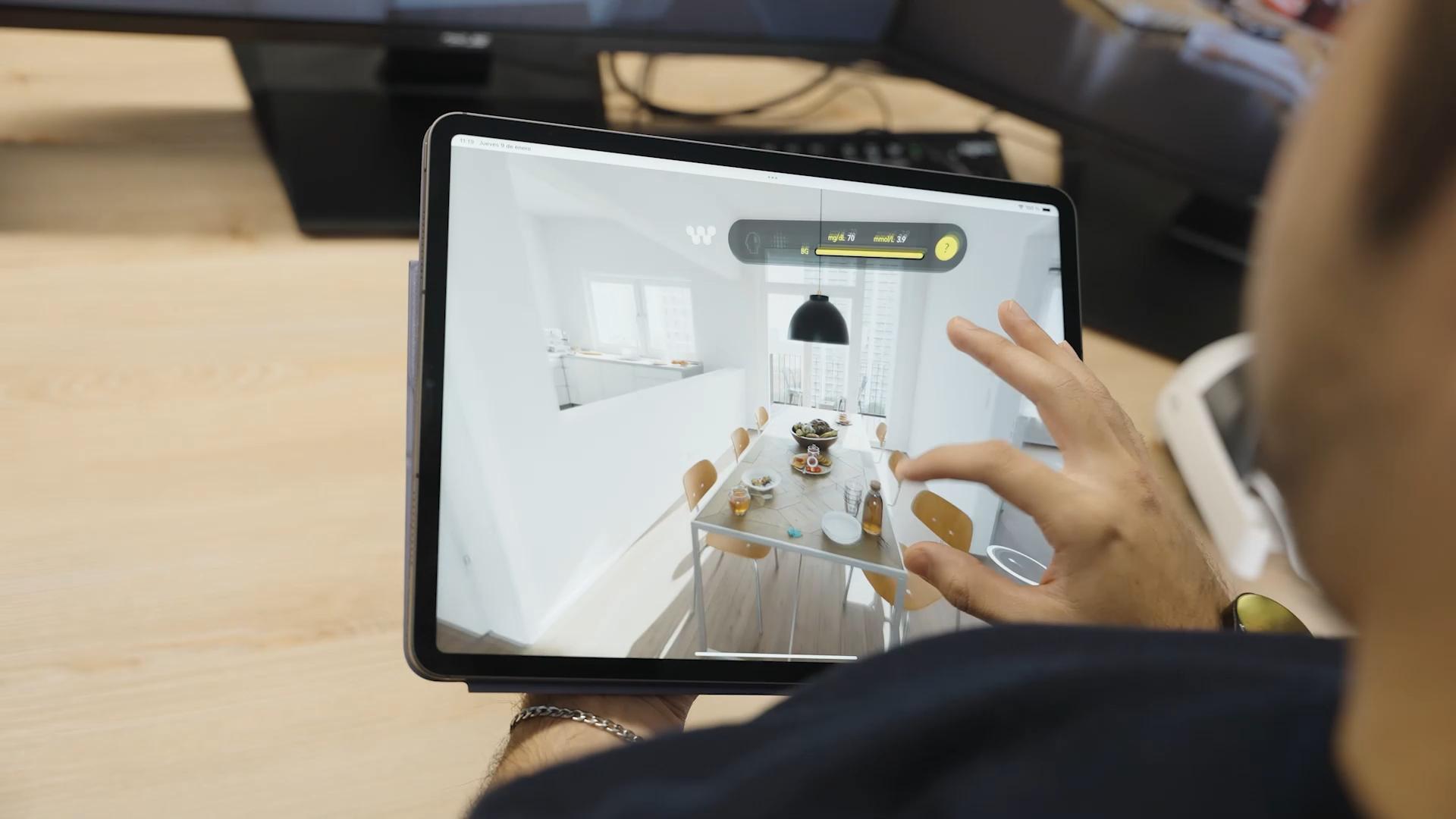
6. Medtronic — explaining an insulin pump to the person who wears it
Medtronic’s system adjusts insulin automatically every five minutes to help people with type 1 diabetes keep glucose stable. The brief was not to impress a clinician: it was to make the concept land with the person who will live with the device.
So the piece is playful and short, and the rule throughout is that nothing appears on screen that the viewer does not need in order to understand the next step.
7. Clínica Jordi Mir — a procedure rehearsed on screen, for the Renuvion Summit
Jordi Mir is a plastic and aesthetic surgeon in Barcelona, at Passeig de Gràcia, specialising in high-definition liposuction with Vaser technology, facial surgery and body contouring. For the Renuvion Summit we produced the 3D surgical animation that accompanies his presentation.
A surgical sequence is judged by other surgeons, so the order of the steps matters more than the lighting. The anatomy has to be recognisable and the manoeuvre has to be the one that is actually performed.


8. Dr. Buccheri — the Inner Bra technique, step by step
Dr. Ernesto Maria Buccheri is an Italian plastic surgeon focused on aesthetic and functional breast surgery. We built the anatomical 3D visualization of his Inner Bra mastopexy technique for congress presentation.
When a surgeon is explaining a technique of their own, the animation is the argument. Every plane and every suture has to be where the surgeon says it is, which is why the review rounds with him were part of the schedule and not an afterthought.
9. Werfen — training on equipment without the equipment
Werfen, a leader in medical technology, wanted to turn traditional training into something immersive and collaborative. We built an augmented reality simulation so that professionals can be trained on the use of medical equipment without needing the physical unit in the room.
This is the clearest case for AR in medtech: the alternative is shipping hardware to every training session, or training on slides.


10. Boehringer Ingelheim — canine anatomy in the consulting room
In a veterinary consultation the hard part is explaining to an owner what is hurting their dog, why, and what can be done. We built an interactive 3D canine anatomy application that the vet uses in front of the owner.
It is a clinical tool rather than a video: the vet drives it, stops where the conversation needs it, and the owner sees the joint being described instead of imagining it.
11. Zeiss — a medical metaverse and a virtual showroom
Zeiss Medical Technology, founded in 1846, is a global leader in medical and optical technology. We developed an immersive medical metaverse — a virtual showroom where their ophthalmology technology can be explored.
The reason to build a space rather than a film is reuse: a showroom does not expire when the congress ends, and the same environment can host a launch, a training session and a sales meeting.


12. Germaine de Capuccini — an interactive hologram of an exosome
Germaine de Capuccini is a Spanish professional cosmetics company that has spent five decades developing formulas that combine science and active ingredients. For the Tecxosome Expert Lab we produced an interactive educational hologram of the biomimetic exosome.
At this scale there is no camera: either you build it or you draw it. The visualization is what lets a professional audience see an ingredient they can only otherwise read about.
What the twelve have in common
None of them started as “we need a video”. Each started with something that was hard to explain: a mechanism too small to film, a machine that is closed, a procedure that cannot be rehearsed on a patient, an ingredient that only exists in a diagram.
The other thing they share is review. In every one of these, someone qualified on the client’s side confirmed that what the piece shows is what happens. That step is part of the schedule, and it is what separates a medical animation from an illustration that merely looks scientific.
25 years turning complex science into something a non-specialist can follow. If you are weighing up a project, the quickest way in is to read what medical animation is and what actually moves the cost.
MORE GUIDES

VR for Pain Management: How It Is Used and What It Takes to Build
What Is VR Therapy? Uses, Limits and How One Is Built
3D Body and Face Scanning for Medical Projects: When It Is Worth It
Digital Human and Avatar Technology: How One Is Actually Built
What Is a Digital Human? Uses in Healthcare and Pharma
Virtual Reality in Psychology: What Is Used and What It Takes to Build
What Is a Virtual Patient? Uses in Medical Training
Scientific Infographic Examples for Research and Pharma

Augmented Reality in Surgery: Use Cases Today

VR Surgical Training: How It Works and What It Costs
Contact
Contact Us
Contact
Contact Us
Boston, Massachusetts, USA
T: (+1) 617 351 8477
M: (+1) 484 473 1704
info@pixel-medical-animation.com
Business Hours:
Mon-Fri: 9am-6pm (local time)
How can we help you?

SERVICES
- Medical 3D Animation in Boston
- Medical 3D Animation in Miami
- Medical 3D Animation in Los Angeles
- Medical 3D Animation in Minneapolis
- Medical 3D Animation in New York
- Medical 3D Animation in Raleigh Durham
- Medical 3D Animation in Chicago
- Medical 3D Animation in Texas
- Medical 3D Animation in Seattle
- Medical 3D Animation in Washington DC