













ABOUT THE SERVICE
Interactive 3D applications
for healthcare and pharma
| 360º Interactive Catalogs | Product Configurators | Immersive Games | Virtual Tours |
| Interactive MOA | Surgical Simulators | VR, AR, XR Applications |
Interactive 3D applications for healthcare are transforming how the medical and pharmaceutical industries communicate innovation, education and technology.
These digital tools allow visualization of biological processes, mechanisms of drug action and medical devices with scientific precision — enhancing understanding and knowledge retention.
Thanks to their immersive nature, these solutions facilitate communication between doctors, patients and laboratories. They are a key resource for exhibitions, educational environments and healthcare marketing strategies.
Interactive 3D applications combine science, design and usability, offering memorable experiences that inspire trust and set brands apart across the healthcare and pharma landscape.
INTERACTIVE 3D APPLICATIONS SERVICES
Interactive catalogs and configurators
We develop interactive medical catalogs and product configurators that allow users to visualize and customize equipment or treatments dynamically and intuitively.
Surgical and educational simulators
We design interactive 3D environments where professionals can practice clinical procedures or explore anatomy and physiology safely.
Interactive MOA (mechanism of action) applications
We create interactive 3D visualizations that explain how drugs act in the body, improving scientific communication and medical training.
Immersive games and learning experiences
We apply gamification strategies in healthcare and pharmaceutical contexts to capture attention and strengthen knowledge retention during events and conferences.
Digital twins of medical equipment
We replicate a complete piece of equipment in 3D so it can be opened, explored component by component and used for training and remote technical support, without having the machine in front of you.
3D showrooms and sales tools
Navigable environments where the sales rep shows the product to scale, rotates it and explains it in front of the client, designed for professional selling and not just for demonstration.
WHO NEEDS INTERACTIVE 3D APPLICATIONS?

Hospitals and clinics
To visualize treatments, procedures or surgeries in a more didactic and interactive way — for both professionals and patients.

Pharmaceutical laboratories
To demonstrate drug mechanisms of action or simulate their effects within the body during presentations, fairs or product launches.

Universities and research centers
To improve teaching and scientific dissemination through interactive experiences and medical education tools.

Biotechnology companies
To communicate innovation, laboratory processes and technologies visually and dynamically, boosting engagement among investors or partners.
EVIDENCE OF OUR IMPACT
+25
years of experience
+1500
completed projects
+100
clients served
What is an interactive 3D application, and when do you need it?
It is a program — desktop, web or tablet — in which the user handles the content: rotating an anatomical model, opening up a piece of equipment, configuring a product, or making decisions and seeing the result. You do not watch it: you use it.
When it pays off
When there is a conversation involved and someone has to convince or teach: a vet explaining why they are prescribing an anti-inflammatory, a sales rep showing a microscope, a technician learning to maintain equipment a thousand kilometres away.
When it does not
If the message is the same for everyone and there is nothing to explore, a video costs less and reaches more people. Interactivity has a price, and it is only justified when the user has something to decide.
BENEFITS OF INTERACTIVE 3D APPLICATIONS
Realistic 1:1 scale visualization
They allow the display of medical equipment and clinical processes at real scale, facilitating intuitive understanding and reducing transportation or setup costs at fairs and congresses.
More effective communication for sales teams
Interactive applications help healthcare representatives clearly explain mechanisms of action or technical features of complex devices, making the invisible visible.
Greater engagement and retention
Gamification and interactivity significantly increase message retention — key to communicating science to doctors, patients and investors.
Website optimization and digital visibility
Integrating interactive 3D experiences into healthcare websites increases dwell time, conversions and brand perception as innovative.
Why Choose Us for Your Interactive 3D Application
Scientifically Accurate, Reviewed by Experts
Your R&D and medical-affairs teams won’t have to fix our science. We build every project on your data and source material, review it with specialists, and represent mechanisms and anatomy faithfully, down to the molecular detail.
25+ Years of Experience with Leading Pharma & Medtech
We’ve delivered work for Hipra, Grifols, Salvat, AstraZeneca, Pfizer, Zeiss, Abbott, Medtronic, and Novartis, among others. Three decades inside the medical field means we already speak your language, clinical, regulatory, and commercial.
Full-Service, In-House Team, From Concept to Delivery
Concept, scientific design, 3D animation, programming, and final delivery all happen with one team. You brief once, coordinate one partner, and receive every format you need.
INTERACTIVE 3D APPLICATIONS FOR HEALTHCARE SPECIALTIES
Interactive 3D applications allow professionals and educators to explore medical and scientific content with visual accuracy and interactivity, enhancing learning, communication and innovation across healthcare disciplines.
Anatomy
We recreate human anatomical structures with visual precision and medical rigor, supporting teaching, outreach and clinical practice.
Genetics
We represent mutations, genetic inheritance and gene editing, helping to understand how genetic information influences health and personalized medicine.

Immunology
We illustrate how the immune system works and how the body responds to viruses, bacteria or vaccines, facilitating scientific and medical communication.
Biotechnology
We showcase biotech applications and genetic engineering processes, from cellular manipulation to the creation of new drugs or biological materials.

Oncology
We represent tumor development and the action of oncology therapies, visually explaining research and advances in cancer treatment.

Cardiology
We animate the functioning of the heart and circulatory system, showing pathologies, surgeries and the effects of cardiovascular treatments.

Neuroscience
We visualize the brain and nervous system in action, from neuronal transmission to the effects of drugs or neurological therapies.
Medical devices
We create animations that show in detail how medical equipment, prostheses and advanced healthcare technologies work — both internal and external.
OUR INTERACTIVE 3D APPLICATION PROJECTS
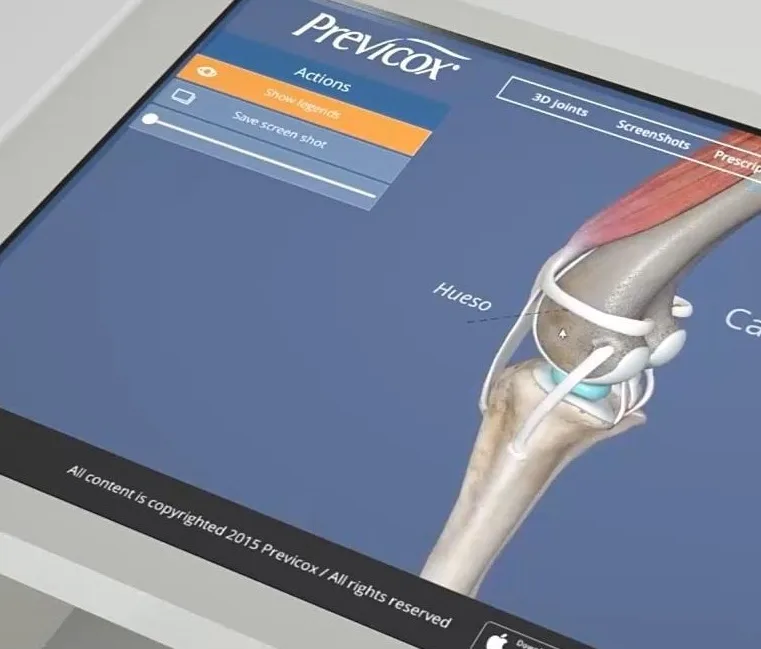
Boehringer Ingelheim – Previcox
360º interactive veterinary anatomy application for optimal prescription of Previcox. Developed to engage veterinarians through high-value educational content.
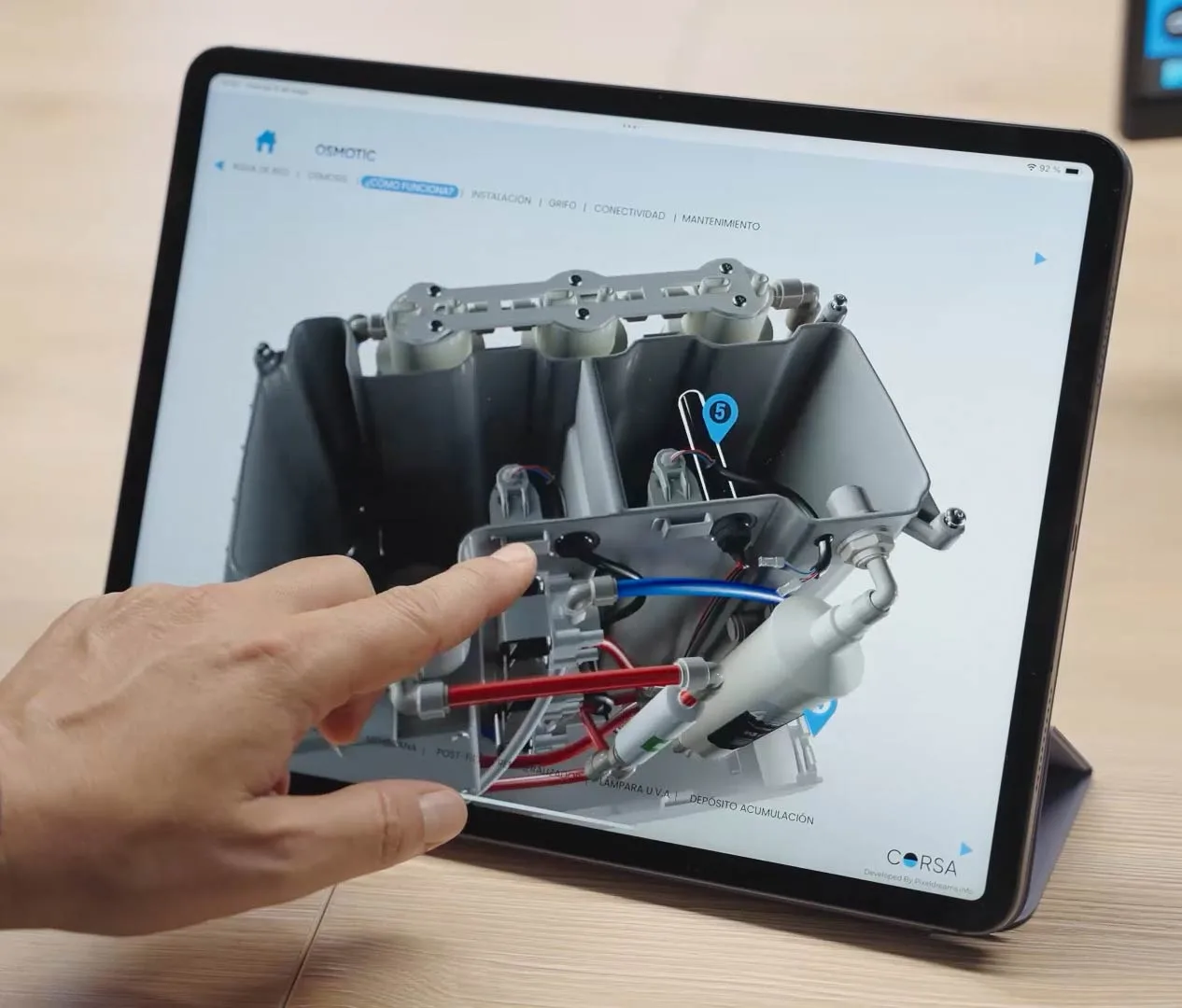
Grupo Corsa – Osmotic Zero
Interactive digital twin of the Osmotic Zero reverse osmosis system, with remote technical assistance through real-time 3D simulation.
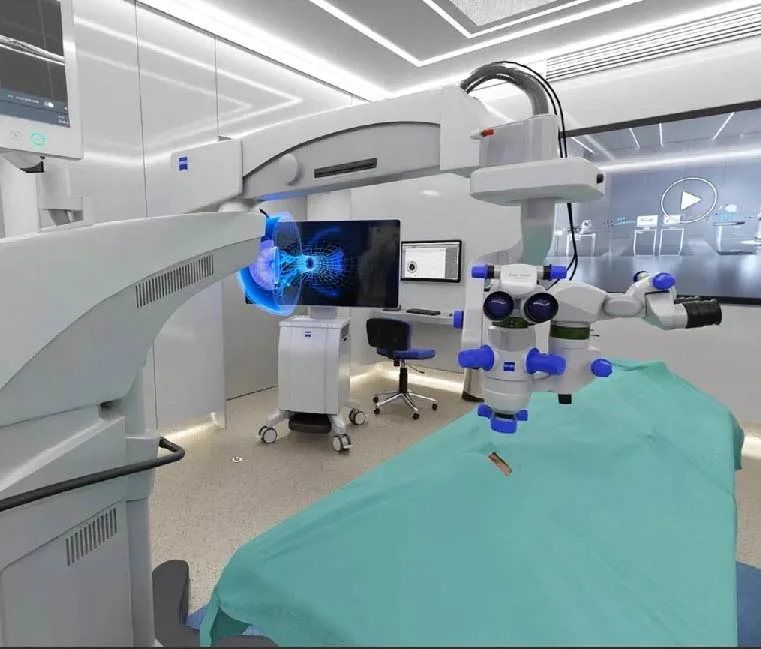
Zeiss Medical Technology
Interactive virtual showroom for the sale of high-precision optical microscopes, navigable in 360º and optimized for professional sales environments.
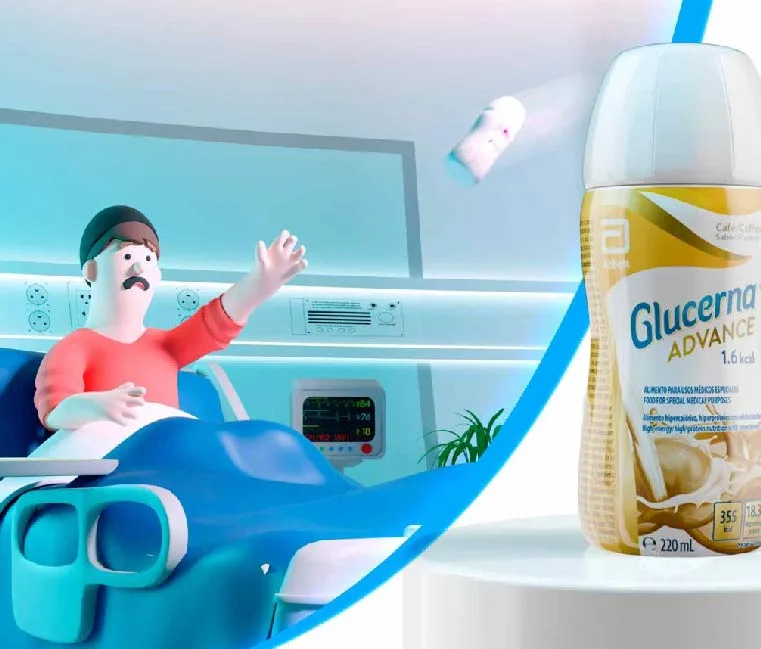
Medtronic – Interactive Nutrition Game
Educational video game for diabetic patients based on nutritional decisions, designed to improve habits and therapeutic understanding.
WORK PROCESS
1
Brief & kickoff
We start from your data, goals, audience, and deadline. You bring the science and the message; we tell you what’s possible and how to make it land.
2
Scientific script and structure
We analyze objectives, target audience and medical information to build a solid and accurate visual narrative.
3
Design, modeling and programming
We create 3D elements, animations and interactive functionalities tailored to the environment of use (web, app or device).
4
Testing and multiplatform optimization
We test the application across devices and resolutions, ensuring fluidity, compatibility and an optimal user experience.
5
Delivery and publication
We hand over the application packaged for the intended devices — desktop, web, tablet or headset — ready to install or publish.
Timelines & What to Expect
You will always know what stage you’re in, what you’re approving, and what comes next.
Projects integrating several devices or high-precision 3D environments can take between 6 and 10 weeks.
Working against a congress or launch date? Tell us the deadline up front.
We plan the entire production backward from it
and after 25 years of trade shows and launches, we’ve hit a lot of them.
FACTORS THAT DETERMINE THE PRICE OF AN INTERACTIVE 3D APPLICATION
Technical complexity
Cost depends on the number of 3D models, interactive features and the level of multi-platform integration required.
Degree of customisation
Apps with advanced gamification, medical simulations or complex animations require a greater investment in development.
Delivery timeline
Projects integrating several devices or high-precision 3D environments can take between 6 and 10 weeks.
Assets you already have
Existing CAD files, 3D models or technical documentation shorten the modelling stage. When there are none, we build from plans, medical imaging and documentation.
Platforms and devices
An application for a single desktop machine does not cost the same as one that has to run on PC, tablet, mobile and headset, with the testing that entails on each.
Scientific content and validation
When the scientific script has to be built from scratch and validated with specialists, the preparatory stage weighs more than when the client supplies the content already settled.
What this Investment Buys You:
Scientifically Accurate
Science that’s accurate and review-ready, not just pretty.
Full Ownership
Full ownership of your project and every deliverable.
Every Format, From One Partner
Every format your team needs, from one partner.
On-Deadline Delivery
A studio that hits the deadline your project is built around.
FAQS
How much does an interactive 3D application for healthcare cost?
It depends on the level of interactivity, detail and features. Each project is evaluated individually.
Can animations or virtual reality be integrated?
Yes. We combine 3D animation, VR and AR to offer complete immersive experiences.
Can they be used at healthcare fairs or conferences?
Yes. We design optimized versions for touch screens and professional exhibition environments.
Which devices are supported?
Our applications adapt to any device: PC, tablet, mobile or VR headset.
What exactly is an interactive 3D application?
A program in which the user handles the content instead of watching it: rotating a model, opening up a piece of equipment, configuring a product, or making decisions and seeing what happens. It can be desktop, web or tablet.
Does anything need installing, or does it run in the browser?
It depends on the project. The canine anatomy application we built for Previcox is a desktop app, because it is used in the consulting room; the Zeiss showroom is navigated in 360° with nothing to install.
How long does development take?
Projects integrating several devices or high-precision 3D environments can take between 6 and 10 weeks.
Is it useful for the sales team?
That is one of its main uses. The Zeiss showroom was built for selling high-precision microscopes, navigable in 360° and designed for professional sales environments.
What is a digital twin, and how is it different from an animation?
An animation plays the same way every time. A digital twin is a replica of the equipment the user interacts with: opening it, exploring it component by component and checking its properties. We built one for Grupo Corsa’s Osmotic Zero reverse-osmosis system.
Can it be used to train technicians remotely?
Yes, and that is what the Corsa digital twin was developed for: making it easier to train technicians at a distance and demonstrate how the system works without moving the equipment.
Can it be used in the consulting room, in front of the patient?
Yes. In the canine anatomy application the vet rotates and zooms the dog model on screen, in front of the owner, to point out the affected area.
Does it help explain why a treatment is being prescribed?
That is exactly what it is for. The application makes it possible to identify areas of inflammation and pain and show how the treatment acts on them, so the person opposite understands the logic of the prescription.
Can you include gamification?
Yes. For Medtronic we developed an educational video game for diabetic patients based on nutritional decisions.
Can you start from our CAD files or models we already have?
Yes, and it shortens the work. Anything that already exists is reused; when there is nothing, we model from plans, medical imaging and documentation.
What is the difference between an interactive application and a video?
A video always tells the same story in the same order; the application is driven by the user. When the explanation has to adapt to whoever is in front of you, interaction wins; when the message is the same for everyone, video is cheaper and travels further.
——— GET A QUOTE ———
Get a Quote for Your Interactive 3D Application
Tell us your project, your audience, and your deadline.
We’ll come back with a clear approach and a fixed quote, usually within 48 hours.
Contact
Contact Us
Contact
Contact Us
Boston, Massachusetts, USA
T: (+1) 617 351 8477
M: (+1) 484 473 1704
info@pixel-medical-animation.com
Business Hours:
Mon-Fri: 9am-6pm (local time)
How can we help you?

SERVICES
- Medical 3D Animation in Boston
- Medical 3D Animation in Miami
- Medical 3D Animation in Los Angeles
- Medical 3D Animation in Minneapolis
- Medical 3D Animation in New York
- Medical 3D Animation in Raleigh Durham
- Medical 3D Animation in Chicago
- Medical 3D Animation in Texas
- Medical 3D Animation in Seattle
- Medical 3D Animation in Washington DC