──── BLOG |
VR surgical training: how it works and what it costs
This guide is written for whoever has to commission a VR surgical training module rather than for whoever will wear the headset. The questions it answers are the ones that come up in that meeting: what it can teach, who has to sign the content, what drives the price and what the hardware decision commits you to.
What VR surgical training can teach
Sequence. The order of steps, and what goes wrong when the order changes. This is what simulation does better than any other format.
Decision under constraint. Two valid options, a reason to pick one, and the consequence shown immediately rather than in a debrief.
Spatial relationships. Where a structure sits relative to another, from angles that no camera in theatre can reach.
What it does not teach is technique in the hands. Without haptics there is no resistance, and resistance is most of what a surgeon is learning when they cut.


The protocol comes before the art
The first deliverable is not a render. It is a document, written by a clinician, that states the correct sequence, the acceptable variations, the failure states and the criterion for passing.
Everything downstream is an implementation of that document. Projects that skip it end up rewriting the logic after the assets are finished, which is the single most expensive thing that can happen to a build of this kind.
Clinical validation is a schedule item
Someone qualified has to confirm that the module does what it claims before it is released, and that review belongs inside the calendar rather than after it. A change at validation stage is a change to a decision tree, not to a sentence in a script.
The same discipline applies to anything we produce with a scientific claim attached, from a MOA animation for pharma to a full simulator.
What actually drives the budget
Number of decision points. Not minutes, not polygons. Every branch is content that has to be modelled, written, built and validated — a module with twelve branches is not twice a module with six.
How much anatomy is new. Reusing assets from an existing animation changes the figure materially, which is why the 3D medical animation and the simulator are worth planning together.
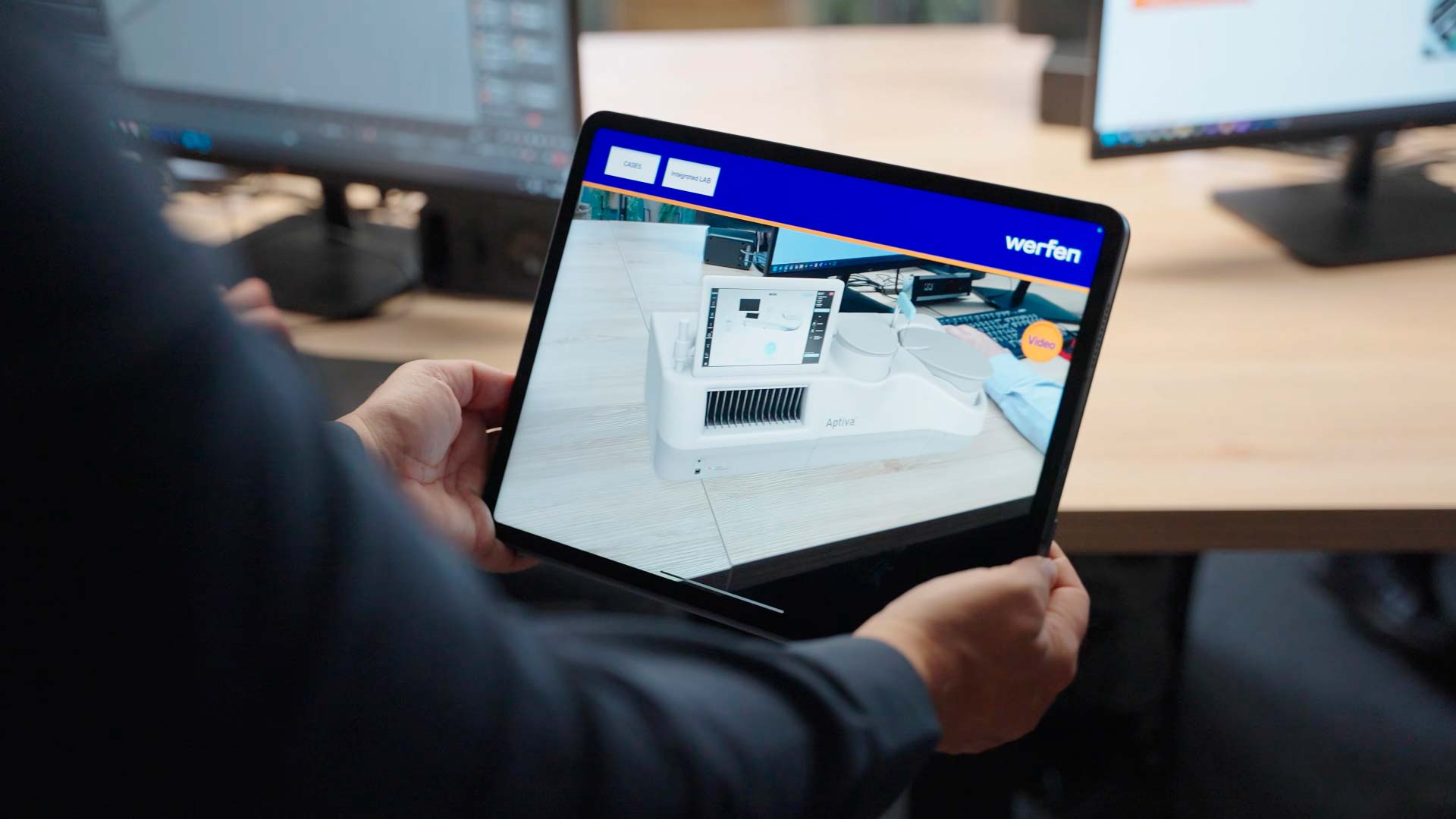
Platform count. Headset, desktop and web are three builds with one codebase, not one build. It is feasible, but it is not free.
The hardware decision, made early
A standalone headset — no computer, no external sensors — keeps the module usable outside a laboratory: it can travel to a congress, sit in a training room, be handed to a rep. Anything that needs a room with tracking equipment changes the cost, the location and the list of people who can run it.
Decide this in week one. It is not a detail that can be left to the end, because it constrains the interaction design.


What to measure, and what to promise
Honest metrics: completion, errors per step, attempts to pass, time on task, and improvement across repeated sessions. A module that records those gives a training department something it can actually report.
Dishonest metrics: operating-room outcomes attributed to a single module. That claim needs a study, not a simulator, and making it in a sales deck is how a good product loses credibility with the only audience that matters.
MORE GUIDES
VR for Pain Management: How It Is Used and What It Takes to Build
What Is VR Therapy? Uses, Limits and How One Is Built
3D Body and Face Scanning for Medical Projects: When It Is Worth It
Digital Human and Avatar Technology: How One Is Actually Built
What Is a Digital Human? Uses in Healthcare and Pharma
Virtual Reality in Psychology: What Is Used and What It Takes to Build
What Is a Virtual Patient? Uses in Medical Training

Scientific Infographic Examples for Research and Pharma

Augmented Reality in Surgery: Use Cases Today

Virtual Reality in Surgery: Training, Planning and the Future
Contact
Contact Us
Contact
Contact Us
Boston, Massachusetts, USA
T: (+1) 617 351 8477
M: (+1) 484 473 1704
info@pixel-medical-animation.com
Business Hours:
Mon-Fri: 9am-6pm (local time)
How can we help you?

SERVICES
- Medical 3D Animation in Boston
- Medical 3D Animation in Miami
- Medical 3D Animation in Los Angeles
- Medical 3D Animation in Minneapolis
- Medical 3D Animation in New York
- Medical 3D Animation in Raleigh Durham
- Medical 3D Animation in Chicago
- Medical 3D Animation in Texas
- Medical 3D Animation in Seattle
- Medical 3D Animation in Washington DC