──── BLOG |
Augmented Reality in Medical Education and Healthcare
Augmented reality puts 3D content on top of the real world instead of replacing it. In healthcare that distinction decides everything: AR is worth its cost when the thing you are explaining has to sit next to something physically present — a device on a bench, a page in a book, a patient in front of you.
This guide covers what AR does that other formats cannot, the applications that recur in medical education and communication, real examples from our own projects, and when a simpler format wins.
What augmented reality actually adds
Context. A mechanism shown on a laptop is information; the same mechanism overlaid on the equipment, the model or the patient in front of the viewer is an explanation they can point at.
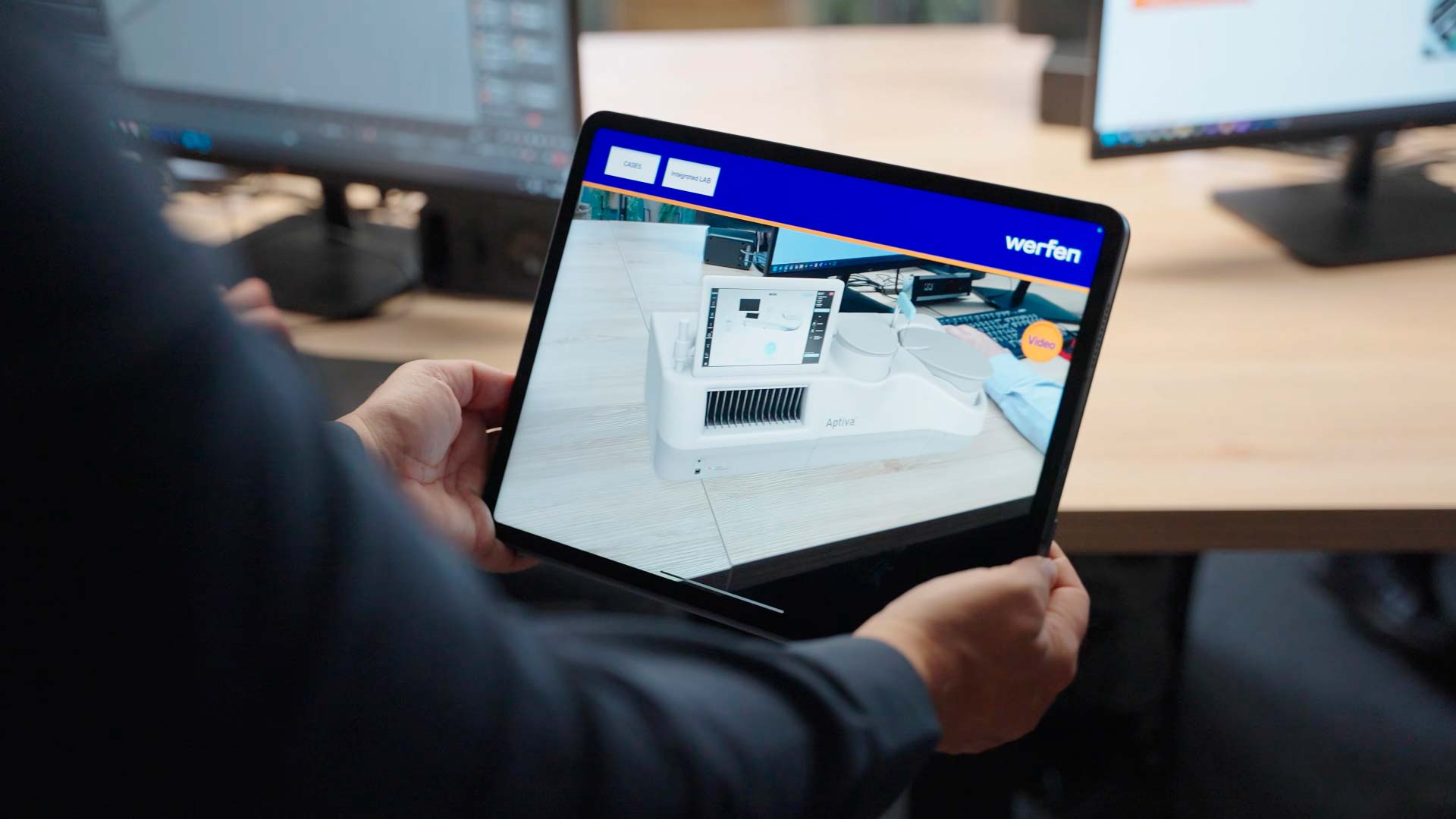
It also removes logistics. Training on equipment normally requires the equipment. Werfen, a leader in medical technology, needed to turn traditional training into something immersive and collaborative without shipping hardware to every session — which is exactly the gap AR fills.
And it is light: most AR runs on a phone or a tablet the learner already owns, which is why adoption is far simpler than with headsets.


In the consulting room: explaining to the person in front of you
The hardest conversation in a clinic is the one where someone has to understand a structure they cannot see. In veterinary practice the difficulty is doubled: the patient cannot describe anything and the owner has to make the decision.
For Boehringer Ingelheim we built an interactive 3D canine anatomy application the vet uses in front of the owner — a clinical tool rather than a video, driven by the professional, stopped wherever the conversation needs it.
In education: turning printed material into something interactive
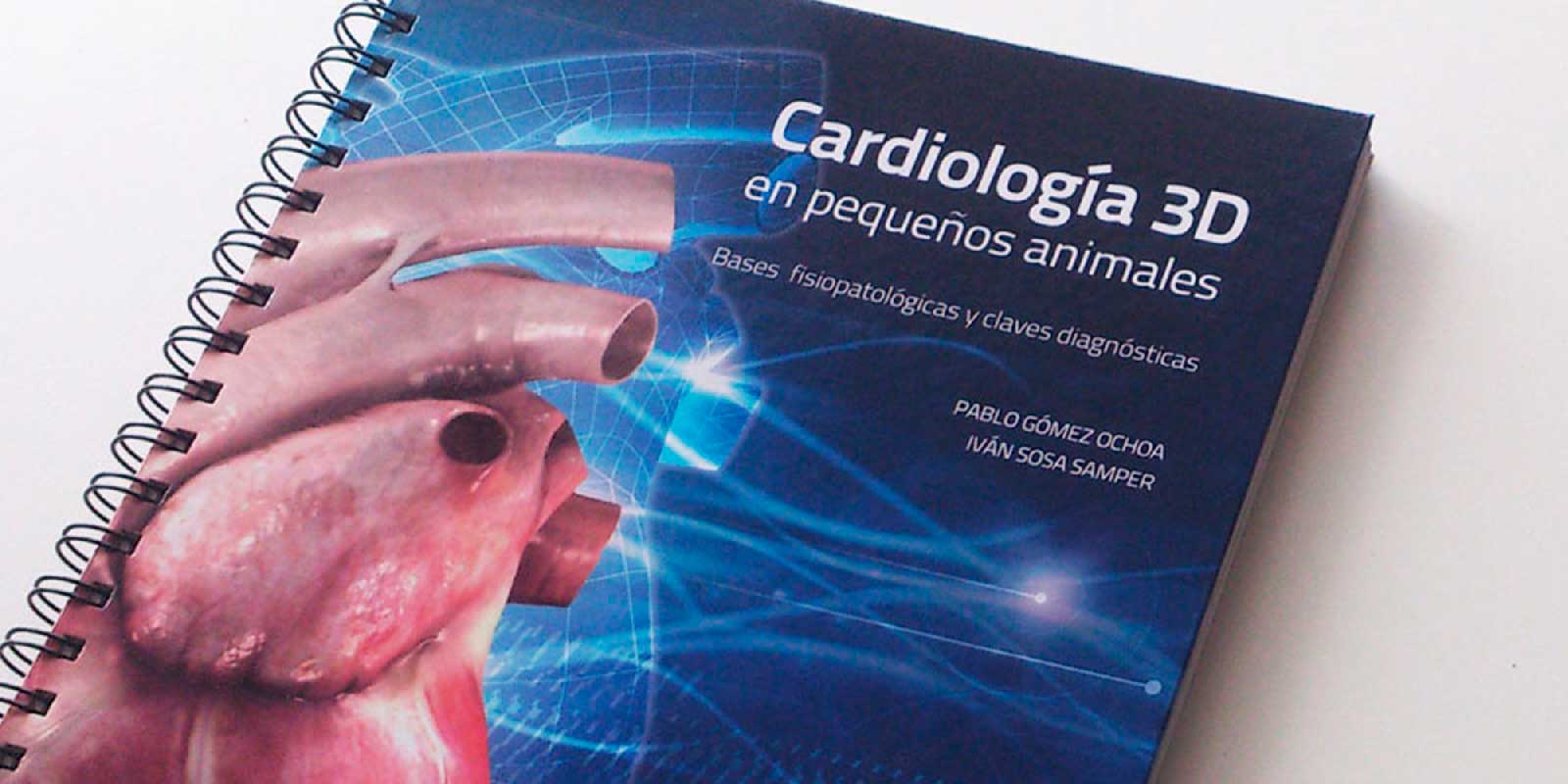
Textbooks are not going away, and AR is one of the few technologies that improves them rather than competing with them. For Servet we produced an augmented reality cardiology book that turns printed pages into interactive 3D.
The pedagogy is the point: the student keeps the book, the diagrams and the index, and gains the one thing print cannot give — a structure they can rotate and take apart.
In product communication: the mechanism in the delegate’s hand
AR is now a standard part of pharma congress work. For Novartis we built an experience that shows the inflammatory process of psoriasis over the real surface, layer by layer. For Esteve, the Ozonest mechanism of action travels in the delegate’s own hand, months after the congress.
And for Fresenius Kabi and Hartmann Medical, AR applications built around their own products and communications — the version of a piece that survives the event it was made for.
When a simpler format wins
When the piece will only ever be watched on a screen. A linear animation is faster to produce, cheaper to review and easier to distribute, and nobody has to install anything.
When the audience is in a hurry. AR has a setup cost measured in seconds of the viewer’s patience — opening something, pointing at something. At a busy stand that is sometimes the difference between a piece being seen and not.
And when there is nothing physical to anchor to. Without a real object in the frame, AR is just 3D with extra steps.

MORE GUIDES
VR for Pain Management: How It Is Used and What It Takes to Build
What Is VR Therapy? Uses, Limits and How One Is Built
3D Body and Face Scanning for Medical Projects: When It Is Worth It
Digital Human and Avatar Technology: How One Is Actually Built
What Is a Digital Human? Uses in Healthcare and Pharma
Virtual Reality in Psychology: What Is Used and What It Takes to Build
What Is a Virtual Patient? Uses in Medical Training

Scientific Infographic Examples for Research and Pharma

Augmented Reality in Surgery: Use Cases Today

VR Surgical Training: How It Works and What It Costs
Contact
Contact Us
Contact
Contact Us
Boston, Massachusetts, USA
T: (+1) 617 351 8477
M: (+1) 484 473 1704
info@pixel-medical-animation.com
Business Hours:
Mon-Fri: 9am-6pm (local time)
How can we help you?

SERVICES
- Medical 3D Animation in Boston
- Medical 3D Animation in Miami
- Medical 3D Animation in Los Angeles
- Medical 3D Animation in Minneapolis
- Medical 3D Animation in New York
- Medical 3D Animation in Raleigh Durham
- Medical 3D Animation in Chicago
- Medical 3D Animation in Texas
- Medical 3D Animation in Seattle
- Medical 3D Animation in Washington DC