──── BLOG |
Serious games for medical training and education
A serious game is a video game whose purpose is to teach or train rather than to entertain. In medical education that means one specific thing: the learner performs the task instead of watching someone perform it.
This guide covers where that pays off, what it costs in production terms, what can honestly be measured, and the cases where a well-made video does the same job for a fraction of the budget.
What separates a serious game from a game
Three things: a learning objective that existed before the game design, a rule set that comes from a real protocol rather than from play balance, and a way of knowing whether the learner got it right.
Remove any one of them and what is left is an activation — fine for a congress stand, useless as training. This is also the fastest way to judge a proposal: if nobody can state the learning objective in one sentence, the project is an activation that has been sold as education.

What medical training gets from it
Repetition without consequence. A trainee can get it wrong, see what follows, and try again. That is the whole argument, and it is a strong one for anything where the cost of a real mistake is high.
A measurable trace. Unlike a video, a game knows what the learner did: which step was skipped, where the hesitation was, how many attempts it took. For med-ed and compliance teams that record is often worth more than the training itself.
Standardisation. Every learner gets the same scenario, in the same order, whatever the instructor is having that day.
A worked example: Glucerna for Abbott
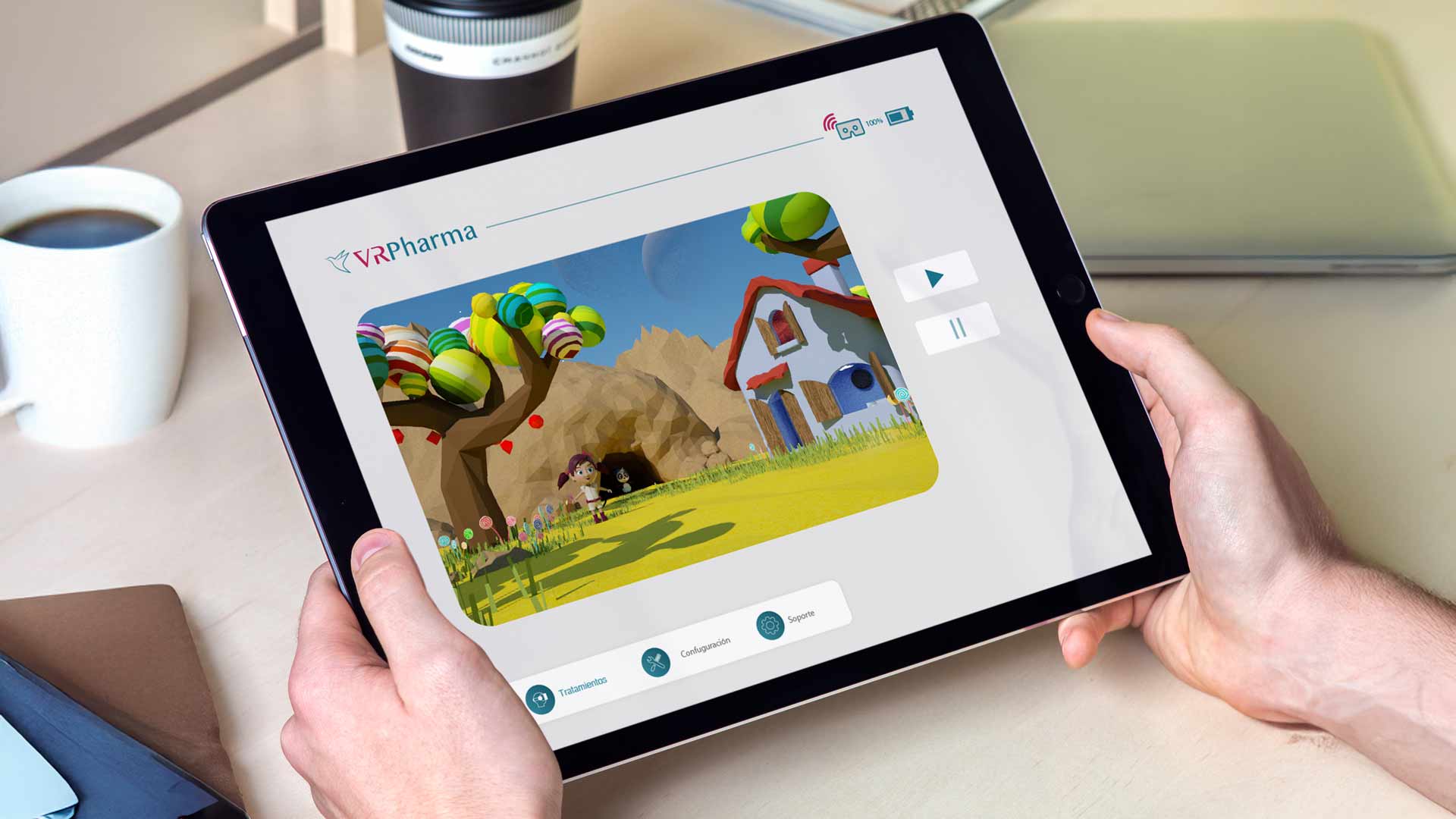
We built a virtual reality serious game for Abbott Nutrition International to launch Glucerna at the SEMDOR 2023 congress in Seville. Healthcare professionals went through a simulated clinical setting and saw how the supplement supports the nutritional health of people with diabetes.
It is a launch piece rather than a certified training module, and it is worth being precise about that difference: the objective was comprehension and recall among HCPs at a congress, not assessment. The mechanics are the same; the claim you can make afterwards is not.


Training on equipment, not on patients
For Werfen we built augmented reality medical training simulation: the trainee learns a piece of equipment that is not physically in the room. It is the textbook case for this category — the hardware is expensive, scarce, often in use, and sending a trainee to practise on it is the one thing nobody wants to schedule.
The same logic applies to any device with a procedure attached. The augmented reality for healthcare and pharma page covers how these are deployed on a phone or a headset.
How one is actually built
It starts with the protocol, not the art. Somebody clinical writes the correct sequence, the failure states and the criteria for passing; that document is the spec. Then the 3D assets — anatomy, device, environment — and then the build, which for anything interactive and multi-platform is the longest stretch.
The part that gets underestimated is validation. Every decision tree needs a clinical review before release, and that review has to be inside the schedule rather than bolted onto the end, because a change at that stage is a change to the logic, not to a sentence.

What to measure, and when not to build one
Measure completion, error rate per step, attempts to pass and time on task. Those are real. Resist measuring attitude change from a single session, because one session does not produce it and the claim will not survive scrutiny.
And do not build one when the content is linear, when the audience will use it once, or when there is no owner to update it after the protocol changes. In those three cases a medical video reaches more people, costs less and ages better.
MORE GUIDES
VR for Pain Management: How It Is Used and What It Takes to Build
What Is VR Therapy? Uses, Limits and How One Is Built

3D Body and Face Scanning for Medical Projects: When It Is Worth It
Digital Human and Avatar Technology: How One Is Actually Built
What Is a Digital Human? Uses in Healthcare and Pharma
Virtual Reality in Psychology: What Is Used and What It Takes to Build
What Is a Virtual Patient? Uses in Medical Training

Scientific Infographic Examples for Research and Pharma

Augmented Reality in Surgery: Use Cases Today

VR Surgical Training: How It Works and What It Costs
Contact
Contact Us
Contact
Contact Us
Boston, Massachusetts, USA
T: (+1) 617 351 8477
M: (+1) 484 473 1704
info@pixel-medical-animation.com
Business Hours:
Mon-Fri: 9am-6pm (local time)
How can we help you?

SERVICES
- Medical 3D Animation in Boston
- Medical 3D Animation in Miami
- Medical 3D Animation in Los Angeles
- Medical 3D Animation in Minneapolis
- Medical 3D Animation in New York
- Medical 3D Animation in Raleigh Durham
- Medical 3D Animation in Chicago
- Medical 3D Animation in Texas
- Medical 3D Animation in Seattle
- Medical 3D Animation in Washington DC