──── BLOG |
Gamification in healthcare: examples that work
Gamification in healthcare gets talked about as if it were a style. It is not. It is a decision about what the audience is going to do: watch something, or handle something and find out what happens.
This guide goes through what the term covers, five pieces we have actually built, what each of them was for, and the cases where a game is the wrong tool and a two-minute video wins.
What gamification in healthcare actually means
Gamification is the use of game mechanics — a goal, a rule, a consequence, a score — inside something that is not a game: a training module, a product launch, a patient education piece. A serious game is a step further: a real game whose purpose is to teach or train rather than entertain.
The useful distinction is not technical, it is about the audience. If the message can be understood by watching, it is a video. If understanding it requires choosing, handling or sequencing something, that is where gamification earns its cost. Everything below sits on that line.
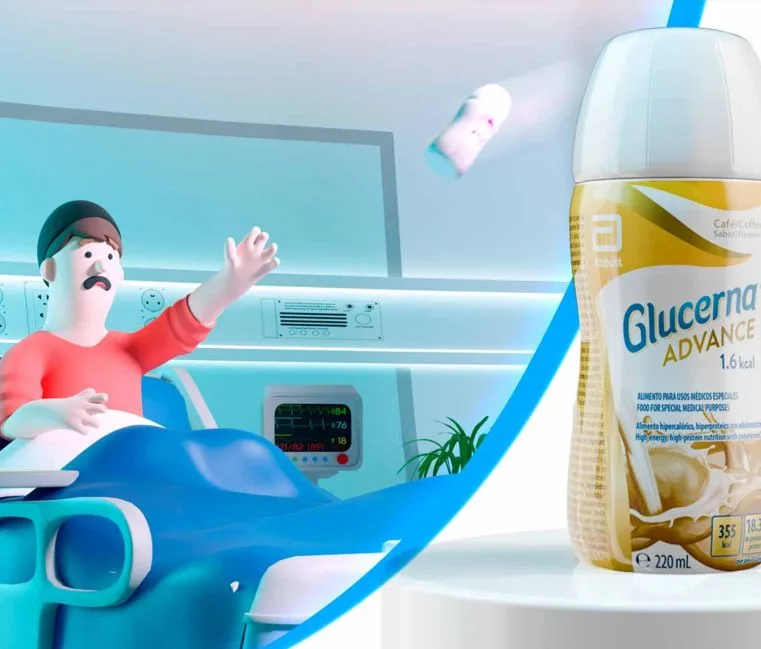

A serious game for a product launch
For Abbott Nutrition International we built a virtual reality serious game to launch Glucerna at the SEMDOR 2023 congress in Seville. Healthcare professionals put on a headset and went through a simulated clinical setting where the supplement supports the nutritional health of people with diabetes.
The point was not the headset. A launch at a congress competes with twenty other stands for the same minutes; a game buys those minutes and, more importantly, changes what the conversation starts from. The visitor arrives at the rep having already done the thing the rep was going to explain.
An interactive experience instead of a brochure
For Evidenze and BioCryst we produced a 3D interactive experience on hereditary angioedema. It is not scored and nobody wins, so it is not a game — but it is built on the same principle: the user drives, the content responds, and the sequence is theirs rather than ours.
This is the most common form gamification takes in pharma, and the most underrated. It needs no headset, runs in a browser, survives a bad congress WiFi connection, and can be reused as a sales tool long after the launch week is over.


Anatomy that can be handled
The interactive 3D canine anatomy application we built for Boehringer Ingelheim is used in the consulting room: the vet rotates, separates and isolates structures while talking to the owner. There is no score here either, only interaction — and that is enough to change the conversation from a description into a demonstration.
It is the clearest example of why the mechanic matters more than the label. Nobody would call it a game, and it does exactly what a game does: it makes the other person participate.
Activations that earn time at a stand
At congresses the scarce resource is not attention, it is minutes. The interactive educational hologram built for Germaine de Capuccini and the virtual fair produced for Pfizer at the SORCOM congress both exist for that reason: they give a visitor a reason to stop, and they give the stand a reason to be remembered after the visitor has walked away.
Measured honestly, that is the return: time at the stand, and recall afterwards. Anyone promising behaviour change from a congress activation is selling something else.


When gamification is the wrong answer
When the message is linear. A mechanism of action with one correct order does not get better by letting people shuffle it; it gets slower. That content belongs in a 3D medical animation.
When nobody owns the content after launch. A game has rules, and rules go out of date faster than a video does. If there is no plan and no budget to update it, it will be wrong within two years and still online.
And when the real goal is reach. A game is deep and narrow; a video is shallow and wide. Choosing the wrong shape is the most expensive mistake in this category.
MORE GUIDES

VR for Pain Management: How It Is Used and What It Takes to Build
What Is VR Therapy? Uses, Limits and How One Is Built
3D Body and Face Scanning for Medical Projects: When It Is Worth It
Digital Human and Avatar Technology: How One Is Actually Built
What Is a Digital Human? Uses in Healthcare and Pharma
Virtual Reality in Psychology: What Is Used and What It Takes to Build
What Is a Virtual Patient? Uses in Medical Training

Scientific Infographic Examples for Research and Pharma

Augmented Reality in Surgery: Use Cases Today

VR Surgical Training: How It Works and What It Costs
Contact
Contact Us
Contact
Contact Us
Boston, Massachusetts, USA
T: (+1) 617 351 8477
M: (+1) 484 473 1704
info@pixel-medical-animation.com
Business Hours:
Mon-Fri: 9am-6pm (local time)
How can we help you?

SERVICES
- Medical 3D Animation in Boston
- Medical 3D Animation in Miami
- Medical 3D Animation in Los Angeles
- Medical 3D Animation in Minneapolis
- Medical 3D Animation in New York
- Medical 3D Animation in Raleigh Durham
- Medical 3D Animation in Chicago
- Medical 3D Animation in Texas
- Medical 3D Animation in Seattle
- Medical 3D Animation in Washington DC