──── BLOG
AEROSPHERE | TRIXEO
See more of our work in interactive 3D presentations
Interactive Presentation of the TRIXEO Inhaler
Trixeo Aerosphere is an inhaler indicated for the treatment of adult patients with COPD (Chronic Obstructive Pulmonary Disease), a chronic respiratory condition that causes breathing difficulties and significantly impacts quality of life. The medication combines multiple active ingredients to deliver effective therapy, and proper use of the device is essential to maximize its clinical benefits.
The challenge of the project was to bring the device closer to the patient in a clear, visual, and accessible way—facilitating understanding of the inhaler while reinforcing confidence in its correct use.
Trixeo & Pixel Medical Animation
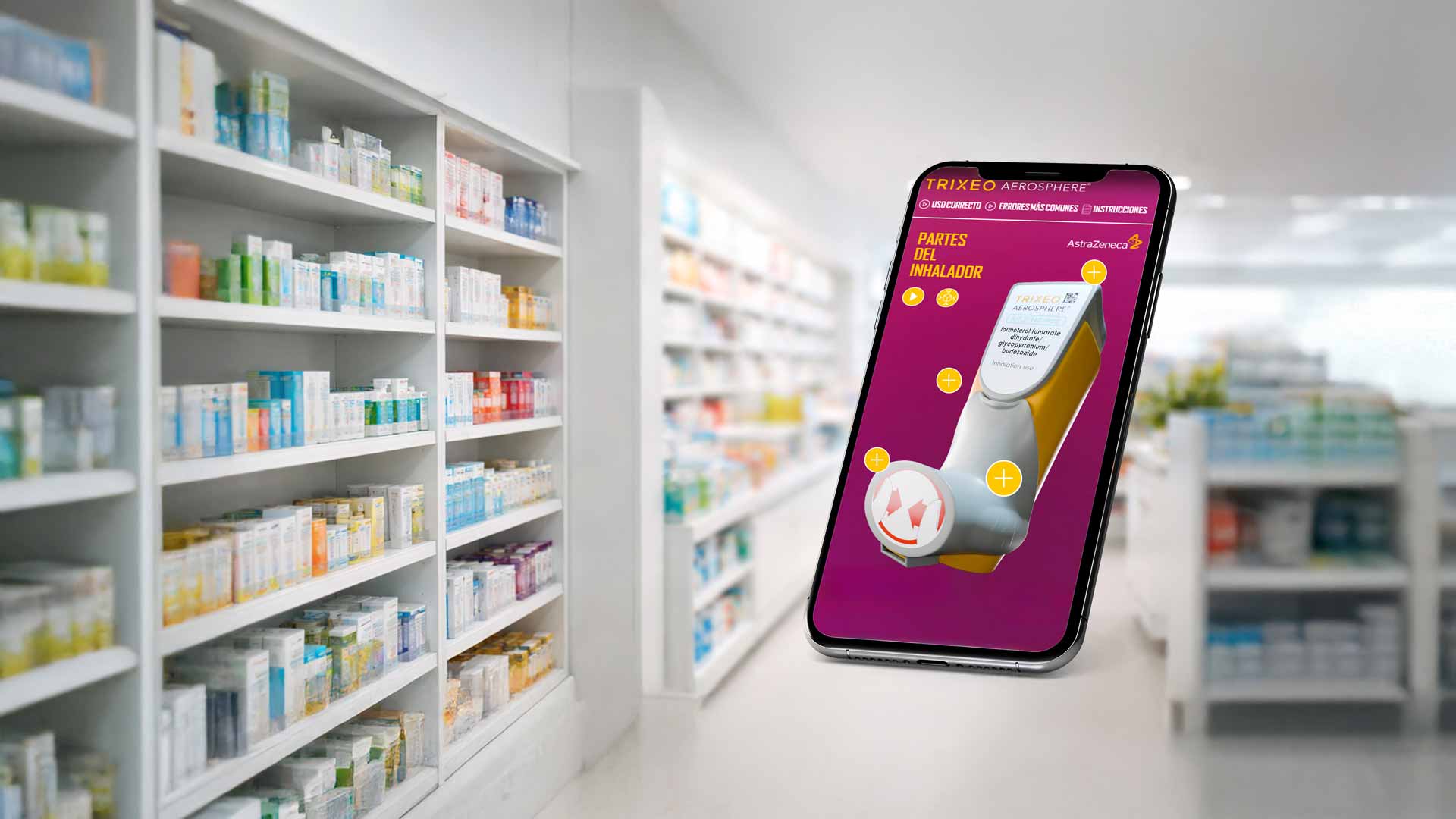
To achieve this objective, the client partnered with Pixel Medical Animation to develop an interactive digital experience based on 360º visualization and web-based Augmented Reality, accessible through a QR code available in pharmacies. This solution allows patients to view and explore the inhaler directly on their mobile device—without the need to download any apps.
The experience is designed to support the patient both at the point of sale and at home, providing an intuitive and modern way to understand and explore the device.
Project Context & Challenges
Augmented Reality enables medical information to be overlaid directly onto the user’s real environment, enhancing understanding, supporting informed decision-making, and allowing products to be visualized in context.
Real-world applications include:
- Simulation of medical devices in operating rooms or clinical settings.
- Real-time visualization of treatments on the patient’s body.
- Interactive promotional materials for congresses and trade shows.
With AR, clinical content becomes tangible, dynamic, and personalized—offering a powerful tool to build trust in both in-person and hybrid environments.
VISUAL INNOVATION FOR PATIENT EDUCATION
We create digital experiences that allow users to explore medical devices in 360º and through web-based Augmented Reality, enhancing understanding, supporting correct usage, and strengthening patient confidence in their treatment.
Projects like this highlight the potential of 3D visualization and web AR to improve patient education and pharmaceutical communication. By combining interaction, visual clarity, and structured content, these solutions transform complex medical information into experiences that are accessible, practical, and easy to understand. At Pixel Medical Animation, we develop digital tools designed to support patients, simplify treatment comprehension, and reinforce trust in healthcare products.
The COPD challenge and adherence to inhaled treatment
Chronic Obstructive Pulmonary Disease is one of the respiratory conditions with the greatest impact on quality of life, and much of its control depends on a factor that is often underestimated: inhalation technique. An inhaler used correctly delivers the dose to the exact point in the airway where it needs to act; one used badly can cut the therapeutic benefit substantially, even though the patient believes they are following the treatment normally. That is precisely the starting point of the project we developed for Trixeo Aerosphere: closing the gap between “taking the medication” and “taking it correctly”.
How the 360º and augmented reality experience works via QR code
The solution is triggered by a QR code placed at the point of dispensing in the pharmacy. Scanning it with a phone camera takes the patient straight into a web-based 360º and augmented reality experience, with no app to install and no account to create. That technical decision — resolving everything in the phone browser, with no download friction — is what makes the tool actually get used at the moment it adds most value: right when the pharmacist hands over the inhaler and the patient’s questions are still fresh.
Inside the experience, the patient can rotate the virtual device through 360 degrees, look at its components and, through augmented reality, project it into their own surroundings as if the physical inhaler were in front of them, visually reinforcing the correct steps in a format that can be repeated as many times as needed, both in the pharmacy and later at home.
Why web-based augmented reality and not a dedicated app
A dedicated app would have required the patient to find it in an app store, download it, install it and, in many cases, register before being able to use it: steps that sharply reduce how many people ever complete the experience, especially within the short window of a pharmacy visit. Choosing web-based augmented reality removes that barrier: the same QR code works the same on an Android device and on an iPhone, takes up no storage, and does not depend on the patient remembering to open an app days later. For a COPD patient profile, where the average age tends to be higher and familiarity with mobile apps may be lower, that technical simplicity is decisive in whether the tool really gets used.
From the pharmacy counter to the living room
One of the aspects valued most in the design of the project was that the experience should accompany the patient at two distinct, complementary moments. At the point of sale, the pharmacist can lean on it to reinforce their verbal instructions about handling the inhaler during the few minutes the dispensing takes. Later, at home, the patient can scan the same code again or save the link to go over the process calmly, without the time pressure of a pharmacy with other customers waiting. That double availability — immediate support and later reinforcement — is what separates a well-designed patient education tool from a single-use explanatory video.
Augmented reality applications beyond the point of sale
The same principle of overlaying medical information onto the user’s real surroundings has room to run in other healthcare contexts: simulating medical devices before a procedure, visualising treatments directly on the patient’s body during a consultation, or interactive promotional material at congresses and trade fairs where each visitor’s attention span is limited. In every case the common denominator is the same as in the Trixeo Aerosphere project: turning complex medical information into something tangible, manipulable and easy to remember.
Designing for a patient who is not comfortable with technology
A further challenge in projects like this is that much of the intended audience need not feel comfortable with technology. The experience therefore prioritises simplicity over sophistication: few steps between scanning the code and seeing the inhaler in motion, intuitive touch controls to rotate and zoom the model, and an interface that needs no prior instruction to start using. Any extra friction at this point — an unclear button, one step too many — translates directly into patients who give up before reaching the part that actually matters: understanding how to use their treatment.
The project also took the real context of use into account: many pharmacies have no open customer wifi, so the experience was optimised to load smoothly over mobile data, with compressed 3D models that do not penalise waiting time at the counter — a technical detail that goes unnoticed when it works, and that is decisive in stopping the patient from abandoning the experience in the first few seconds.
What this approach adds compared with a leaflet or a traditional video
A paper leaflet or a static video explains the process once, in a single order, with no interaction. The experience built for Trixeo Aerosphere lets each patient work through it at their own pace, repeating the parts that raise doubts and skipping the ones already clear. That difference matters especially in chronic treatments such as COPD, where inhalation technique is not learned in one go but usually needs review and reinforcement over the first weeks of treatment.
From a pilot project to a standard for patient communication
Beyond the initial launch of Trixeo Aerosphere, this kind of augmented reality experience reached through a QR code is setting a precedent for how the pharmaceutical industry can support its patients beyond the package insert and the medical consultation. Combining a low cost of access — any phone with a camera and a browser is enough — with a format that can be updated or extended without redesigning the packaging or the printed material makes this technology a resource that suits both a one-off launch and a continuous communication strategy with the patient throughout treatment.
NEWS
The Aesthetic Meet

Werfen Medical | Augmented Reality for Medical Training & Simulation

Boehringer Ingelheim | 3D Interactive Canine Anatomy App

Hartmann Medical | AR Application – DressBox® Hospital Planning

Novartis Medical | Augmented Reality MOA – Psoriasis

Pharma VR | Virtual Reality to Humanize Hospital Care
Contact
Contact Us
Contact
Contact Us
Boston, Massachusetts, USA
T: (+1) 617 351 8477
M: (+1) 484 473 1704
info@pixel-medical-animation.com
Business Hours:
Mon-Fri: 9am-6pm (local time)
How can we help you?

SERVICES
- Medical 3D Animation in Boston
- Medical 3D Animation in Miami
- Medical 3D Animation in Los Angeles
- Medical 3D Animation in Minneapolis
- Medical 3D Animation in New York
- Medical 3D Animation in Raleigh Durham
- Medical 3D Animation in Chicago
- Medical 3D Animation in Texas
- Medical 3D Animation in Seattle
- Medical 3D Animation in Washington DC